Wednesday, 8 December 2010

Brick (2005) A Neo-Noir

In a modern-day Southern California neighbourhood and high school student Brendan Frye's ex girlfriend is missing, he becomes consumed with finding her. He enlists the aid of his only true peer, the Brain. Brendan's single-minded unearthing of students' leads him to rich-girl sophisticate Laura, intimidating Tugg, substance-abusing Dode, seductive Kara, jock Brad and the Pin. Only by gaining acceptance into the Pin's closely guarded inner circle of crime Brendan uncovers the truth about Emily and his classmates and their terrible secrets.
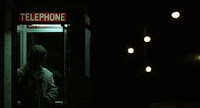
This movie is a great example of modern or Neo-Noir, not only the dark plotline and shady characters but the execution of action, deliverance of dialogue and classic cinamatic teckniques. The snappy dialogue and exchanges keep you an you toes just like the noirs of old. Brendan’s an anti-hero like Sam Spade (the postman always rings twice), aggresivly inteligent and ruthless in his convictions, an outsider and loner with few friends, a model of noir-ness. The Fem Fetal of the picture is played by a pretty doe eyed Laura is just like phyllis dietrich in double indemnity; playing innocent and victimised but truly a dangerous player in the underworld. Low key lighting is used in the more dangerous and suspenseful scenes like when Brendan is taken to meet the Pin, deep shadows are employed in other scenes like Brendan finding Emily’s body in the creek. Long tracking shots and still images of locations create senses of claustrophobia and lonlyness just like noir movies like the maltese falcon.

Preliminary Exercise Evaluation

The purpose of the preliminary exercise was to familiarise ourselves with filming equipment editing software and sound equipment. Overall the sequences were relatively smooth and the action was easy to follow, there was good continuality, the sound was clear, the 180 degree line was not crossed and all action was laid out well on the camera grid lines. There were a few things needed to be improved though. There was no clear establishing shot of the corridor because we focused too much on the feet of the actor and due to rushed filming handles were forgotten to be incorporated, this led to difficulties during the editing process and clipped dialogue.

Preliminary Exercise


This exercise was our first attempt at filming, we were required to show someone making an entrance and starting a conversation with another actor while keeping to the rule of thirds, maintain continuity and use as many shot types as possible

Tuesday, 16 November 2010

Double Indemnity Analysis

Representations :
Phyllis Dietrichson: (first impression) blond beauty, stylish, long suffering wife, slightly abused, introduced into story half naked, drinks ice tea, is in love with Walter.(last impression) femme fétal, manipulative, probably murdered before, unkind to Lola her step daughter, unloving, liar, uses Walter.
Lola Dietrichson: innocent, young, brunette, step daughter, unhappy, secretly dating Nino who her father disapproves of, shown to be crying quite often, mother dead.
Mr Dietrichson: Sleazy, ugly, old in his 50s, sometimes abusive, neglectful to family, drunk borderline alcoholic, does not inspire sympathy from audience, fat, works at an oil field.
Walter Neff: Slick salesman, tall and handsome, successful, talks in fast short sentences, calls Phyllis “baby”, confident, prefers a beer, very masculine, smokes a cigarette, single.
Mr Keyes: short, intelligent, good instincts his “little man”, smokes cheap cigars, Walter’s friend and employer, single though almost married a girl till the “little man” told him to check her background, never seen wearing a jacket or blazer like the other insurance people, a good heart under a hard exterior.

Audience: The audience respond to the characters and situations depending on how they are represented. We as the audience watching the story unfold have ideas put in our heads through out the picture and the people inside it, we have little sympathy for Mr Dietrichson when he is murdered because we don’t like him as we briefly get to know him through witnessing his behaviour ourselves and hearing about his habits from his wife. The audience’s response to Phyllis Dietrichson changes as the plot progresses, at first we strongly sympathise with this beautiful long suffering wife and almost find ourselves egging her on to get rid of her abusive husband, but as we get to know her and hear about what her step daughter has to say about her and we grow suspicious and realise we’ve fallen for it just like Walter.Industry: director Billy Wilder’s directorial choices in this film reflected his belief in the primacy of writing, he avoided the exuberant cinematography and shots that called attention to themselves would distract the audience from the story. Double Indemnity is a typical Claudio Carvalho script and story, full of dark tricks and deception with an unhappy ending. Billy Wilder is in his element in working on such a story and double indemnity was one of his most well-known and celebrated works.

Language: what each character is saying and how they say it has a profound effect on the story and the audience, the movie’s catchphrase “it was murder at first sight” uses the popular saying “love at first sight” so we understand that this is a romantic story with a dark twist. For the most part the tone of all the characters is casual that is only moderated when Walter and Keyes meet an executive of the company. Walter Neff’s language is simplistic, short and to the point, very similar to Keyes’s style and typical of film noir dialogue. Phyllis talks with a smooth breathy tone almost all the time when she’s with Walter but switches to sounding professional and in charge during more formal scenes with undertones of seduction.

Narrative: Walter Neff provides the narration throughout the picture, starting from the first scene as he confesses to the crime in Keyes’s office and during significant moments in the film when its appropriate to know what he was thinking at the time. If Walter had not been narrating in key moments of the film the story would have been harder to follow as it provided a lot of insight to where the plot was going, we could not have known certain things like when Walter was driving away from his first meeting with Phyllis, he described the smell of honeysuckle as he travels down the drive, “I didn’t know then…that murder could smell like honeysuckle” the voice overGenre: As a film noir picture the film must meet a certain criteria; dark deeds, devious motives, black widows, crooked characters and death. Double Indemnity is a quality film noir classic as it provides all the shady twists, flawed characters and murderous plots that noir demands.

Thursday, 4 November 2010

What is Neo Noir?

Neo noir is a genre directly related to film noir, neo noir is basically film noir but with more modern shooting and storytelling while many themes and lighting techniques and Mise en Sene from contemporary noir are used. Contemporary noir themes of cynicism, suspicion, dead ends and darkness are used in neo noir as well as specific characters and roles like feme fatals and hard boiled protagonists are recycled into modern stories with new twists. Some cinematic features of film noir are replicated in neo noirs like Sin City despite technology allowing otherwise has chosen to be black and white, preserving the contemporary noir ambiance and classic feel of grittiness and claustrophobia.


Brick 2005 Directed by Rian JohnsonBrendan Frye is a student of a nameless American High School who finds his ex-girlfriend murdered on the school campus and takes on the challenge of finding her murderer himself. After a frenzied phone call with her the day she was murdered, mentioning “the Brick is bad” Brendan suspects she had fallen in with the drug addict clique. The dark and suspicion fuelled story line and a protagonist searching for answers is a classic recipe for a film noir but modern shooting techniques and setting make it more relevant to today’s audience.


Sin city 2005 Directed by Frank MillerFour tales of crime adapted from Frank Miller's popular comics, focusing around a muscular brute who's looking for the person responsible for the death of his beloved Goldie, another man fed up with Sin City's corrupt law enforcement who takes the law into his own hands after a horrible mistake, a cop who risks his life to protect a girl from a deformed paedophile and a hitman looking to make some cash. The black and white colour scheme marks it out as something different and gives the whole film a nostalgic feeling, the dark characters and the plots they follow are distinctly noir-esque but it is all set in a modern 21 century city.


Blade Runner 1984 Directed by Ridley Scott Deckard is a Blade Runner, a police man of the future who hunts down and terminates replicants, artificially created humans with limited life spans. He wants to get out of the force, but is drawn back in when 4 "skin jobs" (a slang term for replicants) hijack a ship back to Earth to seek out there creators to find a way to live longer than four years. The oriental city that Deckard must search for his prey is huge, smoky and claustrophobic which makes a fine setting for a noir film, modern or classic. The sense that the enemy may be among us in disguise is a theme in noir cinema that can be applied to any vehicle of paranoia in a society of the time, in the 30s and 40s it was the secret police in Europe and in the 80s it was communists and A-bombs, this film brings back that look-over-your-shoulder feel to the cinema that classic noirs mastered and re-models it to a science fiction fantasy that revives the most themes and techniques from the 40s

Tuesday, 5 October 2010

The History of Film Noir


Film noir is a cinematic term used to describe Hollywood crime dramas, particularly those that emphasize cynical attitudes and dark characters. Hollywood's classic film noir period is from the early 1940s to the late 1950s but there have been a few modern films that could be described as neo noir, like Brick (2005).

Although Hollywood made a lot of movies about crime and gangsters in the 40s the term “Film Noir” was not a genre or a name people were familiar with until the 50s when Europe was exposed to the American film industry, before then the films we know as noir classics like double indemnity or detour were put into a category called “pulp fiction” which developed the idea of hard boiled anti-heroes, or were thought of as crime thrillers, it was a French film critic called Nino Frank who first coined the phrase Film Noir. It was these genres that would be the building blocks of the noir genre.

During the Second World War a lot of European Jews fleeing from the Nazis settled in America, here is when German expressionism was first adopted and became a major part of the Noir stylistics. The representation of women was characteristic of the times of the early 20th century when traditional masculinity was threatened by previously oppressed females taking men's roles in life as bread winners, go-getters and ambition chasers after they got a taste of working life when the men were away at war. In the 1930s, women with such characteristics were seen as dangerous and script writers and directors took advantage of the stereotype and gave the world some leading ladies you wouldn't want to meet in a dark ally.

B-movies were another influence in creating film noir, B-movies were cheaply made and had unknown cast members so they were not as regulated as the more popular A-movies, consequentially directors had more freedom to make darker plots and use their own stylistics.

Monday, 4 October 2010

Examples of Noir Films

Double Indemnity: 1944 Directed by Billy Wilder
A salesman of the Pacific All Risk Insurance Co. Walter Neff meets the seductive wife of one of his clients, Phyllis Dietrichson, and they start an affair. Phyllis proposes to kill her husband to receive the prize of an accident insurance policy and Walter plots a scheme to receive twice the amount based on a double indemnity clause. When Mr. Dietrichson is found dead the police accept the evidence of an accidental death. But the insurance analyst and Walter's best friend Barton Keyes does not buy the version and suspects that Phyllis has murdered her husband with the help of another man, not suspecting Walter. Its a cynical, witty, and sleazy thriller about adultery, corruption and murder all usual characteristics of a film noir. Written by Claudio Carvalho

Sunset Boulevard : 1950 Directed by Billy Wilder
Attempting to elude creditors, down-on-his-luck Hollywood scriptwriter Joe Gillis (William Holden) pulls into the driveway of the ramshackle mansion of Norma Desmond (Gloria Swanson) on a stretch of Sunset Boulevard. Norma is a former matinee star from the silent film era and is now a recluse at the house where she lives with Max her all-around attendant. Norma hires Joe to write a screenplay from a stack of handwritten pages she has scratched out for a film of Salomé which she has written to get her return to the screen. Joe takes on the assignment because he needs the money to pay his creditors, but when Max moves all of Joe's possessions into the house on Sunset Boulevard he begins to feel trapped. Needing to finish the script but needing friendship Joe leaves one night to visit his friend Artie Green where he accidentally bumps into studio reader Betty Schaefer. Betty and Joe are attracted to each other immediately but Joe runs back to Norma due in part to his warped sense of loyalty to the older actress. When Joe falls in love with Betty Schaefer, Norma becomes jealous and completely insane and her madness leads to a tragic end. Sunset Boulevard is notable for the atmospheric film noir cinematography of John F. Seitz. Written by Claudio Carvalho